Maria Montessori: The 'Method' That Creates Internalized Authoritarians
October 19, 2026 Reading time: 17 minutes
Note: This article has been translated from Italian into English. The original article, posted on Scuola Libertaria, can be viewed here. Should there be better or inaccurate translations, please feel free to let us know.
"Our children have reached such a level of development that they immediately obey whatever the teacher commands."
(Montessori, The Method, Garzanti, 2023, p. 242).
In our opinion, it would be enough to summarize Maria Montessori's entire work and reveal the true ultimate goal of her intentions, without even having to reference her many other even more disturbing statements. And if you only knew... how we'd love to list all her twisted and dangerous ideas! But that would be too long a list for a blog post. Instead, we choose to take a critical approach, starting precisely from what Montessori said and wrote. We will cite just a few of those ideas, one after the other, to support our critique, which, mind you, is not an isolated one: many intellectuals and educators have distanced themselves from a highly insidious and authoritarian educational method. And we are being generous.
Anyone who has read The Montessori Method from cover to cover (not the summaries, not the slogans, not the Instagram posts, not the claims of private schools, not the self-serving declarations...) will have noticed a disconnect between what is written and what is commonly said about that method. Unfortunately, these days, The Montessori Method is believed in like an idol. It is not discussed, it is not verified, it is not subjected to any scrutiny: you adore it and that's it, regardless. And this doesn't happen by choice, but because the institutional, media, and academic has built a discursive monopoly around that name, a propaganda castle functions as a barrier: those who dare to say that the method contains unscientific, archaic, or spiritualistic elements are treated, at the very least, as an enemy of childhood. The same institutional consensus that is far from confessing to the crowd that The Montessori Method was—as we mentioned at the beginning—heavily criticized by various intellectuals and educators, such as John Dewey, Sergej Osipovič Hessen, Ernesto Codignola, Aldo Agazzi, Gino Corallo, Sabine Seichter, etc. (Agazzi and Corallo are Catholic-oriented educational theorists.)
It is not censorship in the sense of a legal term that the system does not confront the real goals of Montessori (but were they really hers?). It's something more subtle and more effective: the conventional silence about what that method really wants to achieve. Pedagogy manuals treat the method as a 'classic' to be cited, not as a hypothesis to be demonstrated; the media propose it as an extraordinary alternative to traditional schooling; private schools use it as a mark of quality. The result is that a method born in 1907, with its epistemological limitations and its positivist and spiritualist approach, is taught and practiced as if it were a revealed truth and indisputable objective science.
The method that Montessori describes is not scientific in the sense that science is understood to be nowadays: there is no falsifiable hypothesis, there is no control group, there is no replicability. There is selective observation, a spiritualistic interpretation of the development in childhood, and a claim to certainty that Gino Corallo (a Salesian educator) defined precisely:
“Montessori starts from scientism and not from science. The first is a degeneration from the second, because it claims to already know everything immediately while the second is always open-ended and has conclusions that can be revised; it is based precisely on the possibility of the error.”
The most serious issue, which is most overlooked, is this one: as the Montessori philosophy progresses, it slips into a mystical realm. The 'absorbent mind', the 'spiritual embryo', 'cosmic education', the 'meeting of souls' between adult and child are all concepts that do not have any empirical foundation and which belong to the pedagogical romanticism of the late nineteenth century, to that secular spirituality that permeated a certain reprehensible Italian intellectualism of the time. It is what critical historiography has called 'spiritualist involution': the transition from a claim of scientific rigor to a mystical and even esoteric dimension.
Why doesn't anyone highlight this? Because to admit it would mean dismantling an entire economic and institutional ecosystem: private schools with fees that are paid monthly or yearly, paid training for 'guides', certified teaching materials, the 'Montessori' brand which is still very profitable today. The public consensus is maintained by an industry that has a vested interest in ensuring that the method is untouchable. And in this economy of the indisputable, criticism is not prohibited: it is simply not published, not cited, not taken into consideration. As long as The Montessori Method is treated like an idol, Italian pedagogy will remain prisoner to an archaic relic disguised as innovation, even if children actually need pedagogies (we say no, with good reason, as always). Today, Montessori children pay the price for an education that is based on beliefs from 1907, not on evidence from 2026. The same can be said of all those schools that are made pass for 'alternative' and even 'libertarian', but which have remained stuck in outdated notion of school being “in need of reform” and which—ignoring all the subsequent pedagogical developments that led to the awareness of the need of total deschooling—always play into the hands of the system.
A few passages taken directly from The Montessori Method, without any interpretation, would be enough to show that we are dealing with a pseudoscientific and eugenic project, that is based on the myth of race, which is useful only to the military-industrial system, and which shows how—and above all for what purpose—Montessori thought of the child thought by Montessori, and how, according to her, it was necessary to intervene in their development to magnificently manipulate and mold them, making them ready to become a selected producer subject who is perfectly constructed and obedient, at the service of political and economic power.
In 1951 Montessori proposed the creation of a Ministry for the Improvement of the Human Race, a political body that controlled and planned reproduction—that is, the lineage of a nation. Professor and educator Sabine Seichter translates it as the 'Ministry of the Race' (see L'ombra lunga di Maria Montessori: Il sogno del bambino perfetto [The Long Shadow of Maria Montessori: The Child’s Perfect Dream], Beltz, Weinheim /Basel 2024). This is the point where the eugenic framework becomes explicit: the method is an instrument of biopolitics, a way for the state to intervene on reproduction and population selection through education.
In 'Antropologia pedagogica' (1910; English translation Pedagogical Anthropology, 1913)—her true masterpiece, the one that historiography has long ignored—Maria Montessori does not speak of the child in the pedagogical sense. She speaks specifically about race. The child is a developing organism that must be guided towards a form: a form that is, in the words of Montessori, racial, a form aimed at an Aryan idea of beauty physics. We quote:
“Popular education means the improvement of the race.”
“The teacher must assume the new task of correcting what is wrong with the child, with the help of the doctor, to protect the normal child from the dangers of weakening and deformation that constantly threaten them, thus laying the foundation for a magnificent human race, free to achieve the development which it is predestined.”
The ‘magnificent human race', which Montessori identified in that white, Western race, would also be destined to rule the world, according to her. The much-praised educator isn't talking about pedagogy. She's talking about selection. Once more:
"As the child grows, they must acquire not only the dimensions of the adult, but also the harmony of their form; that is, they must reach not only certain fixed limits of size, but also a certain type of beauty."
Beauty. Not cognitive development. Not autonomy. Not creativity. Beauty, understood as conformity to an aesthetic-racial canon. And that standard is explicit:
“Undoubtedly, the most civilized peoples are more beautiful than the barbarians.”
“All errors and paracentral malformations are a physical burden that hinders the perfection of man.”
The logical structure is that of the eugenicist: standard → measurement → classification → correction. The child is not a subject, but a product to be developed. And the teacher does not support and protect, nor do they liberate in any way, but rather they manipulate, train, repair, and correct. There’s nothing revolutionary, then; if anything, everything is traditional and very dangerous. All schools, Montessori and otherwise, covertly pursue the same goal, and unfortunately succeed, as we can see. And let's be clear: if school really changed things, it would be illegal.
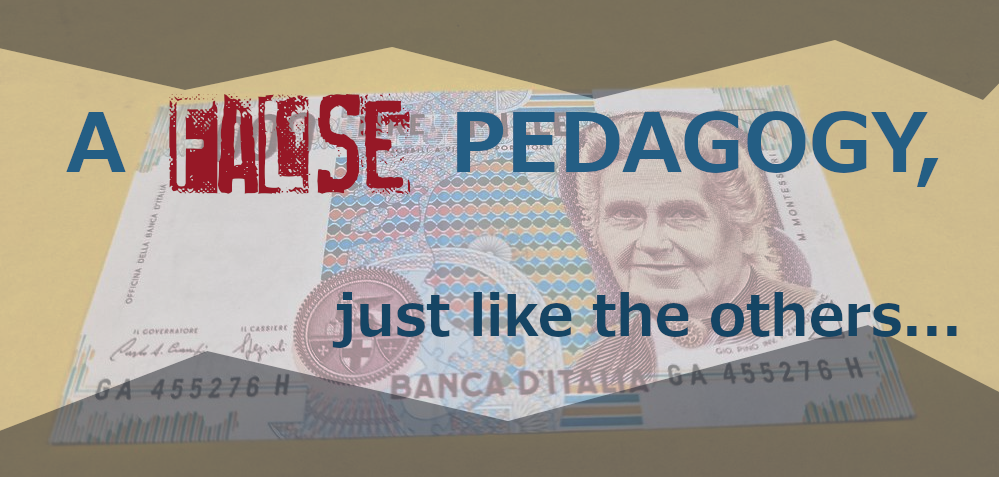
But then, you may be wondering, what are all those flattering educational aspects, all the nice words that are spent when talking about The Montessori Method, all the celebrations and praises that this woman receives from the capitalist system that even dedicated a portrait to her on the 1000 Lire banknote as a seal of her strong allegiance to the system, to the bourgeois national state... what sense do they have? They have the sense of cliché, which unfortunately, also in this case, wins against reality. It's called structural dissonance—the disconnect between brand and the product.
Exhilarating clichés are the result of a narrative simplification: the paradox of the method is flattened to the most attractive aspect (the myth of the freedom). In other words, these clichés are not usually born because people 'don't understand' The Montessori Method but because the method that, from the beginning, has been sold as an idea more beautiful than it really is. And the first to point out its critical issues and inconsistencies are the educators who have experienced it firsthand. Montessori had created her own brand, a real commercial project that was founded on the myth of the ‘FREE CHILD’—a brand that has been marketed to the whole world, with the support of a genuine patent, while making a lot of money. Montessori strategically oriented the method towards wealthy financiers in order to ensure her own economical survival. She was looking for chickens to pluck (suckers to fleece). And she found them. Forget about pedagogy, she was a brilliant manager of her own affairs!
Parents were more dazzled by the brand rather than the actual results of the method, and they did everything they could to enroll their children in those overly controlled, overly organized classrooms, where the walls had to be light-colored—as Montessori said—so that children would learn not to stain them. All this so that their children would be an object of pride for their parents: in high society, they were displayed like puppies in a shop window, obedient and wagging their tails. In short, wealthy families paid dearly to say "my child goes to Montessori," and the idea of a "free child" was precisely the message that justified that price and prestige. But it was just marketing. Even today what is being sold is just a brand.
And you might correctly still ask: “Is the concept of freedom, with the Montessori Method, just a mirage?” How is it possible to consider a child to be free while knowing that they are the subject of someone else's eugenic educational project which seeks to mold them in a predetermined way? But let's explain it clearly, because this is a crucial point where it’s very easy to go astray. If we consider freedom as the ability to apply critical thinking that is capable of questioning the status quo, then The Montessori Method deliberately represses it. And that's exactly how it is. The Montessori Method, in fact, wants a child who knows how to act freely within a given structure, with established elements, but it absolutely doesn't want a child who is capable of questioning that same structure and those elements. The Montessori Method never asks the child why the school environment is like this and not another. It does not ask who decided what is—or what is not—on the shelf. It doesn't ask why the cycle lasts three hours and not four. The method only asks: choose, concentrate, self-regulate. It is relative freedom within a given structure, not opposition to it. And this is not freedom, much less critical thinking; it is a happy adaptation to an enclosure!
This limitation—this ability to act freely and autonomously within a given boundary, imposed from above, and to be even be proud of it—is the fufilled dream of the industry captain and the slave master. And let's not forget that The Montessori Method was developed precisely at the historical moment in which industrialization and capitalism had the need for an obedient and docile workforce, even one that was happy and proud to be exploited in the factory. All the world of capital—governments, banks, finance, industry, and various privileged classes—rejoiced: finally producer subjects were able to perceive their slavery as freedom and who, therefore, would not rebel and would be grateful!
It is also worth mentioning this:
The discipline that is not seen is the most perfect.
In 1907, in San Lorenzo, Rome, the Franchetti Counts observed children working silently, in an orderly fashion with concentration, in a Montessori school. The Roman bourgeoisie—to which Montessori had always looked at as a target audience—was shocked. Not for the freedom of those children, but for the result: children who self-regulated, who respected their surroundings, who didn’t disturb others, who were independent... it truly seemed like freedom, but it wasn’t, and the bourgeoisie knew this all too well. In fact, as we were saying, those children, who were so autonomous in doing what had been prepared for them, represented a true asset for the entire social order founded on the exploitation of man by man. Why?
We repeat: those children, trained that way, are the perfect workers! Perfectly suited to the assembly line! Docile, obedient, and autonomous in carrying out assigned duties, according to set schedules, they don't question the structure and the tools, they have no intention of challenging that given reality—they live it serenely. This system requires masses who discipline themselves in their work and respect schedules, the surroundings, and the sequence of tasks. No one should question the factory, the government, the state, or the school. The state system needs ‘free’ workers in the sense that they don't need a foreman: they've already internalized it! It's no coincidence that the method has been adopted by the elites, private schools, and the most industrialized countries.
Perhaps now it's clearer why the method received Nobel nominations, banknotes, films, and celebratory narratives for Maria Montessori, while the man who recognized children as individuals capable of critical thinking, to the point of questioning the social order—Francisco Ferrer y Guàrdia—was executed by firing squad and, following the international outcry sparked by his death, the closure of his schools and a cruel damnation of memory. The tragic story of Francisco Ferrer y Guàrdia also disproves another cliché: the notion that democracy, presented by the state as the best possible system in the world, is necessarily the best system. It’s all nonsense!
Ferrer’s child wonders why things are the way they are: they are truly free, and therefore dangerous. The Montessori child, on the other hand, happily obeys as part of the herd and responds to the demands of the system. The difference is stark.
Now you know.
Notes:
- Montessori joined the National Fascist Party in 1924. Mussolini was honorary president of the Opera Nazionale Montessori, and in her official texts (1924-1931) she used a biological and racial lexicon: 'the good Italian race,' 'psychological hygiene,' 'great spiritual energies'... The break came in 1934, when the fascist regime wanted to control the schools and she refused, not because of fascist ideology, but because she did not want to lose control—she wanted the control to be exclusively hers. Furio Pesci (Rivista di Storia dell'Educazione, 2021) and Rita Kramer (Maria Montessori, 1988) document the entire phase.
- The most serious critics—Dmitrij Hessen (1934), Codignola, Heinz-Elmar Tenorth (Humboldt of Berlin, 2024)—agree on one point: the method is structurally authoritarian. The child is free in an environment that they have not chosen, with materials that have only one correct use, in predetermined sequences, for cycles of fixed duration. They can't ask why things are this way.
- Montessori explicitly prohibited symbolic/imaginative play as an appropriate activity for young children, replacing it with 'work' on prepared materials (she defined children’s imagination as an aberration, a flaw to be corrected). The American Academy of Pediatrics (2012) and several industry specialists have reported that this underestimation of unstructured play can negatively affect cognitive development and empathy. We can easily believe it.
- Despite the definition of ‘scientific method’, Montessori never used experimental methodology (statistics, control groups, replicability). Her ‘science’ was anecdotal observation and deduction. Critics such as Giovanni Desio and the Moscow Academy of Sciences (in a textbook for Soviet schools from the 1960s) emphasized this: the results were treated as absolute and were without verification.
- There is no universal Montessori curriculum. In theory, any school can call itself 'Montessori' without accreditation. This makes the method impossible to apply in a uniform way and reveals it for what it really is: a brand, rather than a method.
Collective Protocol to Deal with Interpersonal Violence in Anarchist Groups, Collectives, and Movements
May 13, 2025 Reading time: 11 minutes
Facilitated by the Anarchist Coordination Tejiendo Libertad (CATL) and La Pizarra Negra during the First Conspiracy of Anarchist Education and Autonomous Education and includes some additions by the APC.
This event took place in Jovel, Chiapas (territory occupied by the Mexican state) on 10 August 2024. For anyone who wishes to watch a recording of the session in full, videos can be accessed here.
The collective construction of this protocol was done in one of the sessions with organisers and participants in order to create a basic foundation for the prevention and intervention in cases of interpersonal violence within our spaces. The intention is to have a list of considerations so that each group, collective, and movement can develop according to their daily lives and needs. This protocol arises from collective and international needs to signal that internal violence will no longer be tolerated or accepted and that we demand continuous work to end it once and for all.
In this protocol, we ask for sensitivity to the fact that violence can be practiced by people of any gender. As this is a truth of the world we live in, this protocol should be a tool that is used where we take this fact into account. The considerations are divided into three blocks of activities and practices that work together. We have located several of the considerations in a specific part of the process, but they can be used in other parts in order to work on and confront violence depending on the collective. We remind you that this protocol is a guide that must be worked on and adapted within each collective, group, and movement; it is not one that can simply be dropped onto groups under the assumption that it is complete.
One of the issues that we identified when making this protocol is that we lack guides for intervention.1 In order to provide support in this section, we share a directory of collectives that work more specifically with this issue.
Initial Questions Discussed as a Guide at the Beginning of the Session, Collecting Common Experiences in Our Spaces to be Developed in the Protocol
- Asking ourselves if isolating exclusively heterosexual cis men works for us or if we fall into being punitive;
- Learning about community justice or peace circles (from the proposal of communality);
- Identifying the types of violence and how to deal with it based on the severity of the same (e.g., psychological or economic abusers in contrast to batterers, femicides, and pederasts);
- Learning how we plan an escrache (a form of public shaming), how we organise ourselves to do it, and how we support people who've been abused;
- Deciding what can be done based on collective experiences;
- Learning how to avoid the organisation becoming divided as a result of sexist violence and recognising that complaints are not meant to cause demobilisation of a movement;
- Learning about how to protect groups, organisations, and spaces when situations of violence arise within them.
Educational Proposals and Collective Reflections for the Protocol
- Continuous training to raise awareness of violence
- Listening, mutual care and understanding, any necessary support between members, and development of masculinity groups to work on self-criticism: It is important for these groups to recognise violence as a systemic issue. As well, it is necessary to identify the connection of capitalism with patriarchy, which is the power of capitalism against life itself. It is essential to question violence directly, and it is necessary to engage in all forms of criticism, including self-criticism. “If we want to change society, we have to change ourselves.” Members should have access to mutual aid groups that are designed for people, primarily cishet men, to unlearn toxic masculinity within the culture. For example, they should be self-organised by cis men for cis men.
- Violence between members: Communication between members is an important first step. “It is difficult to resolve violence when we, ourselves, do not identify it. Communication channels between members are important to recognise patterns of violence that might have been normalised and affect us in our daily lives.” The best ally of violence is silence.
- The importance of communication between members: The organisation between members makes it easier for them to think more about violence. Questioning the issue of how feminine people are expected to continue mothering cishet men well beyond their childhood, with the expectation that we should be able to set limits about what we are and are not willing to tolerate.
- We should also continue talking about the experiences of the survivors so we can encourage everyone to question the violence that we endure.
- Lifelong and constant learning related to the topic of capitalist and patriarchal violence in our spaces: We have to encourage collective self-critique at all times.
- Listening among peers and making group members more cognizant of internalised patriarchal values: This includes the importance of awareness by cis men and for them to work in the expression of emotions and feelings in all possible spaces, the family, groups, work, etc.
- Mutual support and care for children: There is a need for spaces where children can be heard and supported, enabling them to know that they have a support network and are not alone. How can we create spaces for reflection where they can talk safely and openly about violence? This is important so that all children can be able to identify different forms of violence that exist and how they are able to manage them (as in where to go to find support, who they can talk to, etc).
- Identification of patriarchy and structural violence: Identifying the internalisation of patriarchal values, questioning the complexity of systemic violence and how it is expressed by individuals. To work against these internalised patriarchal patterns, we have to work across multiple spaces: the family, at school, and at a collective and organisational level. We also need to take preventative measures but also have direct and clear intervention actions.
- It is necessary to understand that, while there needs to be differentiated actions taken, we understand the interconnected nature of abuse and violence in different spheres. Things that happen in the ’private’ sphere should not be considered ’private’ matters as they negatively impact upon ’public’ spaces and vice versa.
- Preventive strategies for violence
- Prevention and co-responsibility: Establish spaces free of violence towards women, gender-queer and disabled, children, the elderly, etc. through co-existence agreements. Establish what is tolerated and what is not in relation to the different types of violence. What would be the parameter by which violent members stop belonging to the collectives according to the regulations? Communication between different collectives about these agreements is important.
- Accusation and usefulness of escrache: It is useful to prevent violence from being replicated in other collectives. The importance of the presence male members of the group in issues of sexist violence, listening to each other. In some cases this point can be preventive and information has been shared from another collective when this has been an intervention.
- Identification of violent situations: The importance of identifying intersectionality due to the complexity of social problems, also accepting that violence exists between members. The relevance of history recovery to identify situations we have faced before and take old experiences as a reference so as not to repeat them. Honoring the cases that each person brings from their experiences. The importance of building agency in subjects.
- Re-learning: Differentiating between mothering and accompanying re-learning processes, it is also important to address the micro (Microracism, micromachismo, etc.) on a day-to-day basis, taking these questions to the political sphere of the group/collective/movement.
- Collectives must manage therapeutic and/or emotional support for those who need it, regardless of whether their needs arise from having exercised or suffered violence within the collective. We are all fragile and need care. Caring for mental and emotional well-being is also caring for our collective health.
- Intervention strategies in cases of violence(2)
- Mutual care and support for victims: We believe that it is important to talk with members to provide necessary emotional, psychological and practical support on everyday basis to the victims and assaulted people, communicate among ourselves and then present the problem in the assembly.
- Expulsions of aggressors from organisational spaces: As members of the groups that compile this report, we believe that it is important to continue reflecting on the issue of the expulsions of aggressors from organizational spaces because we believe that there are situations that merit expulsion in order to support the victims and for the aggressor to start therapeutic processes and unlearning/relearning in order to build safe spaces that follow the development of intervention protocols in the spaces. Expulsions must be a strategy that is part of the restorative proposal.
- Mediation for conflict resolution: Mediation from like-minded groups is important, particularly through people outside the collective that are aligned with similar values. We should start with direct action towards reparation with the support of members who have experience in conflict resolution.
- Restorative proposal: In the restorative process with violent members in the group, it is important to work with those who do not recognise their own patterns of violence. It is important to identify the privileges that masculine members have in comparison to feminine members, such as when masculine members presume that their time and work are more important than those of feminine members. Within our collectives, we have to understand that the psychological and economic responsibility depends on the situation, and we should identify the restorative justice processes so as not to involve state mediation. Aggressors must take accountability and make their own proposal for how they are going to change their behaviours and attitudes, presenting it to the assembly of the collective. It must include doing care work within the work tasks in the collectives, regardless of gender.
Footnotes (to be fixed):
1 One of the issues that was identified in the international gathering that happened in Chiapas is that the Mexican members said that they experienced a lack of guides for intervention regarding interpersonal violence within their own contexts.
2 This English version reorganises these points to reflect common understandings in many Anglosphere spaces, but the Spanish version was written in the order of the discussion.
Tourism and Apps: All You Need to Learn a Language, Right?
February 3, 2025 Reading time: 5 minutes
by Carl Eugene Stroud | PDF version
According to the Google Play Store, the mobile app whose official name is "Duolingo: Language Lessons" has surpassed 100 million downloads. It has an average rating of 4.7 stars after more than 17 million reviews, and there's a reason for that. Language learning apps like this present an effective way of putting world language study into everyday life. On top of that, the negative opinion of games for educational purposes doesn’t really exist anymore. Learning is a playful act, and it benefits adults just as much as kids. As a language instructor, I have seen how much you can learn from vocabulary and grammar exercises available on your phone. However, you can see from the most popular, top reviews on Google that even Duolingo fans recognize the contradiction: playing alone isn’t a way to eventually talk to others.
With this problem, like in all contexts under capitalism, the dominant response comes from the bourgeoisie. "You can only learn languages by traveling abroad", they repeat while selling us tourism and exoticism as solutions for language learning. As a result, language acquisition is seen as a luxury that costs too much for the working class. This mythology makes us think that multilingualism has no place in our own local communities when it's actually the extractivist conception of foreign languages that we should not allow. We don't have to wait for the vacations that will never happen under this system. If technology is already connecting us, why not appropriate these connections for our own purposes?
We must recover the lost tradition of pen pals because, contrary to the adventure pics we see on Instagram or the points earned for consecutive days on Duolingo, true internationalism is based on interpersonal connections, not on looks or rewards. Luckily, there are already other apps we can use that are perfect for this! They're not exactly for studying languages but instead are for communicating, for video calls, for attending conferences around the world, and for updating us on the daily lives of people in various international contexts.
The first thing is to overcome the isolation and geographic distance that, in the past, separated far-off communities. By reorienting email and business meeting platforms, we can make them work better for us. The problem is not the internet, which we all depend on to connect us internationally; the problem is the false promise that we will find language skills like treasure on exotic beaches. When it comes to learning about different cultures, there isn’t really anything like traveling to other countries since the famous "total immersion" isn’t always as productive as we might expect. Tourists don't have access to the "authentic" experience of a culture without having already met local people beforehand, without having formed friendly relationships before arriving at the chosen destination. Again, my main proposal for solidarity updated for the 21st century: let's use things like email to become corresponding comrades.
From the beginning of the process of learning a new language, it's possible to start by writing: emails introducing yourself, simple comments on social media posts, and short responses via direct messages to interesting people or organizations. Don’t already know any people or social media accounts in your target language? Give in to the natural ability of humans to lose ourselves in the labyrinth of the internet. It's easy to endlessly binge watch educational videos in your preferred language. This drop in a bottomless well will cause the algorithm to recommend more and more content in the language that you want to learn. Also, following accounts from various countries that address similar themes makes it clear that the information on the internet is much more vast than what can be understood in one language.
In my decades of contact with foreign language learning, on both sides of the student/teacher dynamic, I have encountered recurrent doubts about the fruitfulness of these approaches. Students say that it’s too bold to contact people directly, that it’s confusing where and how to start, that the discomfort is too much. To me, this is a perfect description of an international, multicultural, and plurilingual situation, full of complications and difficult to navigate. Yes, it can be intimidating, but only at first, until you get used to it. For this reason, practice is just as important as knowledge. Because the internet reduces the social pressure of communicating, it works perfectly for experimenting and for growing, little by little, the confidence to participate in conversations with people you already know about subjects that are already familiar with.
Ultimately, mobile apps should be used to help us to overcome the fear of communicating directly with others when we are learning a new language. They will not teach us how to speak or listen, but they can help us begin to escape a monolingual and monocultural perspective. The knowledge offered by Duolingo, much like the myth of touristic language immersion, can’t change our original perspective. That perspective is anchored in our native language and country of origin. However, we can gain a new perspective by participating in international conversation: a multifaceted view rooted in the diversity of its many participants. We can use the internet to establish connections with real people, who can teach us about their actual lives. These connections will expand the reach of our local, cultural communities and will strengthen the international solidarity of the working class.
Disability Inclusion Guidelines
February 3, 2025 Reading time: 21 minutes
written in collaboration with Steatornis
Table of Contents:
- Why We Need Guidelines
- How to Identify Your Own Needs and How Organisers Should Meet Them
- Inclusion and Accessibility as Cultural and Political Practices
- A Few Guidelines
Why We Need Guidelines
Despite the fact that it should be obvious, inclusion benefits you, your communities, and our struggles for liberation. Inclusion is the practice of cooperation that is required for you and those around to be able to thrive and participate in equity during any activity. By ensuring that inclusion is actually being done in our spaces, it lessens the risk of burnout and, more importantly, works as a harm reduction that takes actions to make sure that our spaces can support a diverse set of people. This dissolves the capitalism-supporting practices of accepting harm (done by ourselves or others) into our bodies, minds, and lands.
If you're serious about genuinely building community and practicing mutual aid, you will learn to cooperate to achieve this goal and honour the boundaries and cultural practices of those around you, yourselves, and the lands in which you reside. Refusals to do so perpetuate the oppressive systems responsible for colonialism, capitalism, and the eradication of diversity within and between lands and people. Inclusivity is cooperation, cooperation requires mutuality, and mutuality requires honouring the boundaries of our surrounds and demands a give-and-take to build inclusive movements together.
How to Identify Your Own Needs and How Organisers Should Meet Them
Colonialism, ableism, sexism, transphobia, homophobia, adultism, and racism suck. This should be obvious, though we still see many of these being reproduced within our own spaces and events. They constantly reproduce historical oppressions and are the driving forces behind the neglect of our own bodily needs that keep us from liberating ourselves. Capitalism relies on the suppression of our bodily needs to function, as doing so removes key knowledge of how to set boundaries. Boundary-setting—heeding the limits of the self and others—is the very foundation of mutuality, which in turn is a foundational in community creation and maintenance.
To effectively set and honour boundaries, it is necessary that we acknowledge, listen, and respect the self, others, and the lands around us. In the event that this skill is lacking, the probability of becoming an oppressor is high. Notably, being an oppressor is exceedingly common and a factual non-insulting statement of what is; it is not a permanent state of being, but it is the state of our colonial selves and something that often governs our beliefs and behaviours.
To recognise a need within yourself, we must start by giving names to body states: "I'm hungry" or "I'm tired" or "I'm anxious." The emotions that have names are possible to perceive and, in organisational levels, you need to have the structures to meet these needs without capitalising on them nor expecting people to handle them entirely on their own. From this starting point, it is a long life's work to collectively construct the structures in our communities based on principles of mutuality and better understand what needs these emotions may hint at.
For instance, when a person says "I'm hungry," it may camouflage other needs: being cold, indecision, boredom, or nothing sounding good to eat. Being able to recognise the different meanings behind a deceptively simple statement can help both the individual and the group to better understand these needs and make them clearer, which also helps to prepare for these varying needs in the future. Perhaps the person may not be able to eat certain kinds of food or handle certain textures, meaning they cannot consume what's available; maybe they have an eating disorder that needs to be addressed or is triggered by certain foods; or they could be food insecure but unsure of where or how to ask for help. Being able to better explain the issue clarifies what is needed for everyone, allowing the person to state directly what the issue is and better ensures that they get what they need. The act of putting words to the facts allows us to also wish for and name what we can do to change the situation. Doing this serves two purposes.
First, it helps people to name their state of being while also making them more accustomed to wishing in their day-to-day life. Such every day wishes are an integral part of dreaming, which can branch into an action. Of course, it might also not generate action as someone could have disabilities, intense social pressure, or shame working against them. However, wishing for something (like wanting a lower temperature) can still spur someone to take action (altering their state of dress, finding shade, finding water, and so on). If someone is unable to specifically name their needs, that's fine; it takes time to even be able to name your needs if you're not accustomed to doing this or haven't had the space to actually name them in public. We're better at doing this in the privacy of our own company, and it can be quite difficult doing it in front of others, regardless of who those "others" are.
Second, in the context of heeding someone's needs during an event or within an organised space, it helps if the organisers model the desired behaviours. They should shamelessly ask for water whenever they need it, openly acknowledge the need for a quiet space even in the middle of a presentation, or directly ask for help with technology or for help finding items (like pens and paper). This does not make people comfortable doing these things, but it sets an example. Organisers should be aware that attendees may want to show them respect and further oppress themselves and their own needs as a perceived social benefit, since this is the expected action to take in a social setting.
It is absolutely essential that organisers do this because of how difficult it can be for others to put their immediate and urgent needs first. Many people will often put their needs off for later as a sign of respect, which is something that we have been taught to do over the course of our lives in many different contexts. Putting off our needs is a form of self-oppression, and it is one that we often do to ourselves without even giving it a second thought. This also includes us enduring events for longer than we otherwise might be able to in certain contexts, such as needing to take a break or to simply leave due to feeling unwell. For this reason, it is better if the organisers incorporate this understanding into the design of their event or space. Not only should it be an inherent part of our structures, but we all need to see organisers and others clearly honouring break times without deviating from them. It sets a precedent for everyone.
In most cases, people require guidance in order to identify their self-oppression, why it happens, and how to heed their needs. Organisers need to be aware of this, particularly as the capitalist helhole we live in incentivises and rewards ableism and lateral violence (e.g., urging others to also oppress themselves). It is in the realm of organiser responsibility to anticipate this and to do whatever they can to mitigate the harmful effects caused by ableism.
Inclusion and Accessibility as Cultural and Political Practices
"Inclusion" and "accessibility" are sets of cultural practices that interface with a vast network of colonial structures. What these cultural norms and practices entail varies greatly between different groups of people, localities, and their surrounding influences. The concept of "universal access" carries a lot of eurocentrism and Western bias, as it does not specify for whom something is accessible. An example of this is the interaction between disabled people and the natural world. A capitalist may demand a mountain hike be made accessible through modifying the landscape and installing pavements, whereas others—in cooperation with the living land—may define the mountain accessible if the general populace's attitudes are that of cooperation or the land is whole.
An example of this that has been made known to us comes from the Sámi community: Two of their main festivals on the Norwegian side of the border are held in places where the land is not paved. On one hand, white disabled people claim that the Sámi festivals are inaccessible to those who use mobility aids; on the other, Sámi people say that the locations where the festival is held are accessible to all, regardless of mobility aid use. White disabled people have heavily hinted that the festivals should be moved, whilst disabled Sámi people work with the land. The prefer the festival locations remain as they are and define accessibility as communal support and mutuality, opting to make changes to workflow and the organisations to accommodate and anticipate community needs for access and inclusivity. In general, altering the land to accommodate disabled people is frowned upon, as we and the land co-exist. Therefore, significant alterations to the lands is considered to be self-eradication by Sámi people, and the preferred way of overcoming accessibility challenges to any space is through community effort.
It is important to note that all biases (eurocentrism, colonialist, racist, ableist, misogynist, queerphobic, etc.) be examined ahead of organising events and throughout the existence of communal spaces. It is easy to use accessibility and inclusion to further oppression if you are introducing these concepts to communities who may not have previously had the words or infrastructure to accommodate its disabled populace. The reason for this is because of how this type of work needs to interface with colonial structures: laws, bylaws, permits, etc. They all influence which choices are available or unavailable to organisers and their communities. Although we fight for liberation for all, we are not separate from the clutches of those structures that can permit disabled people to exist, especially as disabled people are perpetually faced with the removal of support at any moment from just about everywhere on the planet.
Additionally, every community has its own ways of addressing and talking about disability, access, and inclusion. There is a tendency in Western colonial spaces to view disability and its related words as synonyms of weakness and consequentially avoid naming structures and features of disability, access, and inclusion. Conversely, disability is a variation of life—a factual and fluctuating state of being alive that ebbs and flows. Each and every living being will, at one point in their life, become disabled in some way—temporarily or permanently. As such, disability is innate to each living creature and the lands in which we reside. This also means that, at some point, every one of us will speak about disability, access, and inclusion in ways that run counter to someone else's self-determination. While it may create a moment of unpleasant feelings, it can be resolved through communication, dialogue, and sharing perspectives.
Notably, colonisation of the mind and lateral violence is rife in this area of liberation. Many of us still struggle with engaging in acts of self-oppression along with directing our anger and aggression toward members of marginalised or oppressed communities rather than aiming it at the actual oppressors themselves. This may make inclusion work challenging, but it is precisely because of those challenges that these initiatives are all the more pressing. Through addressing them, we may heal the harm brought onto ourselves and our surroundings little by little. Ableism permeates our world, even and especially within anarchist spaces. It is spread and reinforced through colonialism and imperialism, and dismantling those structures is integral to creating and maintaining our communities.
A Few Guidelines
The following guidelines are strongly recommended but are by no means the only ones. This can be used as a reminder for planning events or developing communal spaces, and it can be used as a way to think about how we can better develop our learning over time to improve access to such needs.
Communication and Information Availability
- Be clear about the main language of communication while also permitting other linguistic expressions, offering translators if possible. This includes having sign language interpreters in the local sign language(s).
- Present information both in writing and with audio. This should be done in several languages in order to support linguistic solidarity and to better break down borders. Remember that it takes a few more minutes to have short manuscripts or transcripts of the sesions for those who need them.
- Thoroughly plan the sessions and presentations in your events and how they will be offered (e.g., live-only, hybrid, livestreaming, etc), ensuring that people can participate regardless of their health or economic background.
- Be upfront about accommodations that are not available, especially when asked (e.g., if there is no sign language interpretation available, say that).
- Make visual and informational presentations of the participants in the events, describing what they look like, which pronouns they use (should they want to discuss it), and the clothes they are wearing.
- Describe pictures and photos when you show them, explaining the details, people, colours, and the actions happening in them.
- For written materials, try to use sans-serif fonts with a minimum font size of 12pt.
- Ensure that visual and written materials have good contrast, including trying to create versions that support colourblind people.
- Use alt-text and captions on everything that is visual, including pictures and audio. This is particularly important for online
- materials, especially to engage with people who have limited access to data.
- Organisers need to operate with two plans: organisation and production plans (which are plans for behind the scenes operations) and the program plan (for the attendees).
- Send any electronic information, guidelines, outlines, or presentations to participants ahead of time.
- If there is an audience-based discussion following a talk or presentation, try to aim for well-formed and focused questions about the topic to avoid excessive deviations and side-tracking. Try to be concise, if possible.
- Make sure that your technology works head of time (e.g., have a backup USB stick and extra cables).
- Make sure that presenters and participants use a microphone. It is not option because speaking loudly and yelling is not enough (and not everyone is able to maintain that for a length of time).
Health and Environment
- Make a clear map of the space and post it clearly, especially at entrances. People can get easily lost, and others might explain directions in confusing ways.
- Avoid wearing perfumes and colognes or using strongly scented products (e.g., cleaning supplies), as this can exacerbate issues for many people (including those with allergies or prone to scent-induced headaches).
- Bathrooms should be gender neutral if possible and accessible for disabled people. If there is not a possibility to have one in the same building, organisers need to make agreements with nearby establishments for free use of their bathrooms.
- Provide menstrual products in all bathrooms without being requested to do so.
- Maintain a first aid kit and enable spaces for people to learn first aid.
- Plan for breaktimes and honour them. Break times should be no less than 15 minutes in order to accommodate people with disabilities and neurodivergences (sensory breaks, destressing, accommodating for transition times, etc).
- Provide hand sanitiser and other cleaning wipes or products to help facilitate healthy environments.
- If masks are required, provide free and accessible masks for participants to use.
- Ensure all spaces have proper ventilation.
- Ensure that the acoustics of the space are okay. This includes making sure that spaces do not have echoes or do not contribute to additional distracting noises like reverberations or hearing other meetings outside of the space the person is in. Consider that spaces with walls made of windows or metal have among the worst acoustics possible.
- Think about the lighting in the room. Try to make sure that all lights are working properly and not flashing or flickering. Try to use indirect lighting sources, avoid rooms with fluorescent or other white lights if possible, and consider external sources of lights (e.g., windows).
- Ensure that venues have presentation spaces that are large enough to allow for people to get up and walk rather than forcing people to sit still. Also make sure that people have easy access to leave any space in case of personal and communal emergencies.
- Ensure that there are a variation of places to both sit and lie down and that these can accommodate people of various body sizes. For chairs, try to avoid only having seats with armrests and try to get chairs of differing heights. We should also provide space that allows for people to just sit or lie down on the floor.
- Create quiet spaces for people to relax and chill between activities or presentations, without visual or auditory stimulation.
- If you're going to have events in a place with stairs, make sure that there are elevators for people with different kinds of mobility, children who use strollers, or any other person who may not be able to use stairs consistently.
- Create tactile pavements indoors and outdoors if they are not already there so that people can navigate their way around a space easier.
Mutual Care and Community
- Have safe spaces for babies and children in order to include and facilitate the participation of single parents and any kinds of other families. Children are integral for community building, both in terms of allowing families to participate but also in terms of passing knowledge on to new generations.
- Provide and make easily available family spaces for changing and nursing. Ensure that these are separate from disabled toilets, which decreases unnecessary conflict between people.
- Serve free food and drinks during activities and events, providing lists of allergens and ingredients that are in food or drinks.
- Support people in bringing both service animals and pets to spaces and events, providing space for play, rest, care, and access to water.
- It is the responsibility of the organisers to ensure that accommodations for people who travel to spaces or events exist prior to participants asking for them. It is not good enough to simply tell people to look for hotels or other nearby services. The best case scenario is that there are free places to stay and that it is organised among the local organisers and participants, especially as we cannot expect those who are invited to come to the event to know the chosen location.
- Anarchist gatherings, spaces, book fairs, or any other meetings are opportunities to create mutual aid activities. It is possible to make available access to free clothes, kitchen utilities, or anything else that people can use on a daily basis in order to build up and support the local communities where the events are held.
Additional (but Still Important) Considerations
- Always ask before doing anything that involves touching another person or their mobility aids, letting them know ahead of time if possible. Obviously, there may be times where this is not possible, like ensuring someone's safety to prevent them from getting hit or falling. However, unless it's truly an emergency, don't just touch or move people because you think you're "helping" them.
- Be aware that it's okay that certain needs will contradict others. It's not a big deal if that happens, but you should be flexible enough to try and accommodate people as much as possible.
- Language matters. Fascism is not a mental disorder or a disability. Stop comparing all negative behaviours to mental disorders and disabilities. An individual person with a mental disorder or disability can be a fascist, but that is *not what makes them a fascist*. The same thing is true of bigoted people, abusive individuals, or others who intend to cause harm to others. We should avoid using ableist language that conflates these issues.
- We need to do more than be aware of things. Awareness is good, but we need to create more opportunities to directly deal with issues at hand.
- If you're going to have tickets or any other payments, have differentiated prices and be explicitly open to people who have absolutely no means to participate economically. Do not penalise people for cancellations, refunding whatever was paid. Money should only be kept if the person indicates that they want to donate it or do not wish for a refund.
Against Anarchism's Academisation
February 3, 2025 Reading time: 8 minutes
We write this text with the biggest preoccupation, grief, anger, and frustration. Many of us have been aware of the co-option by many academics and academic institutions; we have been aware of how academic circles constantly co-opt anarchist theories, analysis, and authors. We also have experienced a larger number of anarcho-curious academics who think anarchism is an “interesting” theoretical framework for them to explore while then bringing with them a wrecking of the social, political, and economic critique that decades of anarchist activisms have developed around our principles. We believe that this is the natural consequence of the scientific method that was embedded into neoliberalism, which fragments everything and destroys the connections between our everyday struggles to political analysis, causing us to lose the radical and militant parts that help us understand and adapt to these historical times. As they "study" anarchism, they use it as if it were a new toy in their thought experiments, while constantly trying to shove it into their neatly labelled academic boxes and refusing to recognise that it (like many things) will never truly fit. This is, of course, seen from a white European perspective because we are aware that a lot of groups and spaces outside of that region are much more aware of the importance of the resistance against the academisation of anarchism, and they tend to be much more coherent and consistent in their praxis.
In the last few decades, we have experienced how academics have used anarchism as a theoretical tool, though they have not done anything to bring about change with regards to the increasing ecofascism, corporativism, and globalisation of neoliberalism in the last 40 years. In addition to this, we have a myriad of examples of anarcho-curious people destroying anarchist groups from the inside when they infiltrate anarchist spaces with their own capitalist values where hierarchisation, oppression, and individualisation are introduced into our spaces. This helps to destroy our organisational capacity because they create and maintain power dynamics that give many of us even more work to do. We don’t just have to try to create new radical spaces against our classic common enemies, but we also have to fight our internal saboteurs. It is not strange that a lot of comrades are absolutely burnt out. This internal sabotage by the anarcho-curious has happened in many different spaces, from radical publishing houses to squats or book fairs. Time after time, we experience an alienation from our own principles and spaces because we won’t deal with our own internalised oppressive attitudes that prevent us from behaving in ways aligned with anarchist principles, and we allow an additional destruction when our own spaces become altered by the deradicalised, dissolving all of our theoretical analysis.
No gods, no masters, no husbands…and no academic idols.
We want to focus on the last part of this sentence. In our everyday struggles, we want to ensure that we are giving space to activists who most of the time either are in prison, upholding local communities, being criminalised, or are simply just trying to survive in this ecocidal post-capitalist phase.
Here is where our anger arises: All of these anarcho-curious people are impostors from the academic world, and they are just co-opting our principles in order to pretend they are radical and keep on climbing the academic ladder. Instead of actively participating in anarchist spaces and actually engaging with any of the projects around them that seek to reject capitalism, they come to merely visit and extract information for their own personal gain. There are no ethical boundaries for how they approach their work and even fewer with regards to their direct impact on the support and aid that our comrades in the streets receive.
Then again, we have some academics who in a certain degree actually try to practice the ethical coherence that is demanded of defining ourselves as anarchist, and we don’t academise our activism. On the contrary, we hold our roots directly in the struggles, being very clear that working in academia just helps us pay the bills. We are workers with a social status, but we are workers nonetheless.
That is why we are utterly enraged when, in the last couple of weeks, we have encountered some situations that exemplify yet another fight we must undertake. That is the use of certain anarchist figures who are tokenised by academics in order to pretend that their work brings radicality and real change in the world. This, of course, is done in absolutely disgusting liberal spaces and organisational structures that absolutely do not have any pretense whatsoever of neither opening for anarchist theoretical work nor the abolition of oppressive structures or neoliberal values. They abuse certain Western anarchist figures in their own impostor syndrome so that they may gather funding which is then used to support the careers of certain academic individuals but never to support anarchist and other aligned radical groups or spaces, and they never even try to give mutual aid to oppressed people. In other cases, we have self-defined anarchist research groups that are tainted by using neoliberal buzzwords or only ever welcoming openly anarcho-curious academics in their research spaces like an ideological poison.
It would be lovely to know what the hell the David Graeber Institute, the Emma Goldman Awards, the Ferrer i Guardia Foundation or the Anarchist Virtual University: Ivan Illich are thinking when they either do not mention the political background of the people whose names are being idolised or openly conflate people with ideologies they did not claim. They also fail to explain how in the hell they will defend the use of these figures in neoliberal practices, though that would be quite difficult to do when they're so clearly maintaining them. Some of these groups are based in academic contexts and headed primarily by academics while using academic structures and rules; others are directly supported by governments or fall under a government scheme, literally bringing more and more radical work under the control of the state and its institutions. According to the missions of these organisations, some openly state that you must continue contributing to the work of their chosen individual and continuing their vision, putting the focus entirely back on that idolised individual over anything else. We wonder how these individuals would feel being memorialised in this manner. Would they come back from their graves only to have a heart attack at the sight and die in flames once again?
The betrayal and dangerous dissolution of the radical ethical coherence in anarchism between our everyday struggles from the theorisation of anarchist principles might be one of the reasons why anarchism is not perceived as a real threat anymore. We are aware that both in the US and EU contexts that anarchists are criminalised, but we can’t accept to become academised and neoliberalised just for our own survival and that of our ideas. Actually, we should be defending ourselves from these awful attacks; we should fight against the academisation and tokenisation of anarchist historical figures, theories, practices, and work. In centering only a few names and ignoring their own anarchist positions and how those positions impacted their own time on this planet, we would be fighting back against what should be seen as nothing more than an open attack on our own principles.
We don’t want academic idols. In fact, we don’t want any idols at all. It’s one thing to be grateful for having people who have helped us with their activism and through their writings to continue the construction of free societies based on anarchist principles, but it is something completely different to abuse their names only to pretend to be radical when the only thing you do is to destroy long radical traditions that have constantly been under attack and for which a lot of individuals have paid and continue to pay the price for with their freedom and their lives because they continue to fight against every hierarchy that threatens the liberation of all people.
We are aware that the recognition of individual work is important, but we still must kill our idols, even when they work in academia. We hope that several comrades can become aware that we are all flawed humans and that any historical anarchist figure, like ourselves, has never been perfect. The struggles have always been collective and so has our resistance, and so our fight should still be to abolish any oppression at the same time as we build strong alternatives outside the state, capitalism, and other oppressive institutions.